
Mansplaining: Communication is Key

At a party, a man and a woman are discussing a book. The man explains the book in a high-flown, confident manner, making sure the woman doesn't get a word in edgewise. A friend of the woman, also present at the party, has to repeatedly reassure the man that he's talking to the author of the book before he finally shuts up. This is an anecdote from the beginning of Rebecca Solnit's "Men Always Explain Everything to Me."
What is mansplaining?
Mansplaining is a slang term derived from "man" and "to explain ," coined after the 2008 essay " Men Explain Things to Me – Facts Didn't Get in Their Way." The term is often used to address men who explain something to a woman in a condescending, overconfident, and often inaccurate or oversimplified manner, usually to a woman who already knows a lot about the subject. However, if there is a demonstrable difference in knowledge, it is an explanation, not mansplaining.
There's no clear consensus on whether mansplaining also occurs between men or women; opinions differ among various researchers. In my opinion, it does indeed occur due to, for example, power constructs and perceived superiority between conversation partners. But this has less dangerous consequences than the origin of the term.
Where does the behavior come from?
According to Garjan Sterk of Radboud University, it has a lot to do with socialization and how this is taught to both men and women. Men learn to overestimate themselves, while women are told to be modest. This is sometimes even unconsciously instilled in their upbringing from childhood. More about male behavioral expressions can be found in the following blog post: Positive masculinity unraveled; What should a man be?
When a woman expresses a (strong) opinion on a social media platform, for example, the reactions to her are often hateful or threatening. And almost half of the time, sexist in nature, as the following Dutch research image shows.
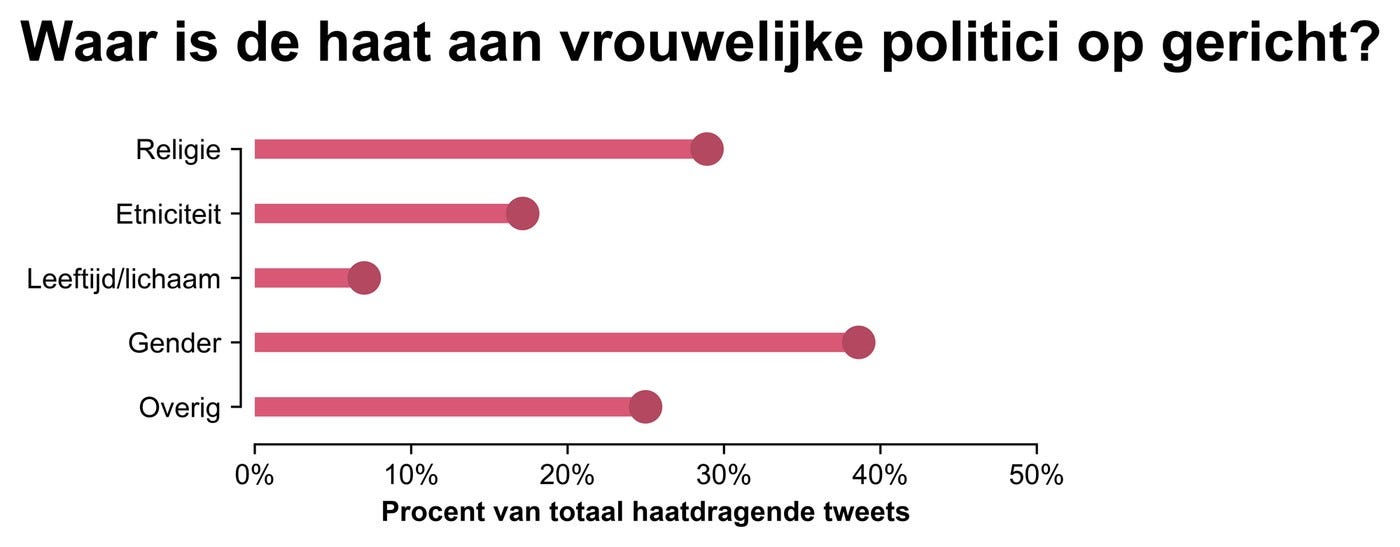
Where is the hate towards female politician on Twitter focused on? In order: religion, race, age/body, gender, other.
Often this stems from toxic views that I have written about before, which can be found on the blog: Redpilled: The Rise of Young Conservatives.
Forms of communication
Communication styles are not genderless and can be traced back to prehistoric times, according to Darwin's theory of evolution . This was related to the division of labor among individuals. Male hunters specialized in pursuing prey and strategic thinking, pursuing a single goal and using specialized communication to achieve it. Women often multitasked, which, according to Darwin's theory, resulted in a specialization in social organization and is still considered a key pillar in how various forms of communication emerged.
Since the rise of feminism, rigid communication styles have changed, and there's been more focus on incorporating other communication styles into one's own. Men are therefore more in touch with their feminine side, and vice versa.
What's important to know about communicating with men is that conversation almost always has a purpose. To be honest, we often don't even initiate a conversation unless there's a reason. That's why male friendships can sometimes stagnate for months or years, only to rekindle as if it were yesterday when they need each other. Talking for the sake of talking often feels pointless with a male communication style.
With a more feminine communication style, you communicate with the goal of understanding others better, thus better expressing feelings and thoughts and creating a balance between the conversation partners.
The communication styles described above are primarily based on neurotypical communication. There are many more ways of communicating, and they vary from person to person, so don't be blinded by the examples above. Communication remains a key that opens the doors between different worlds of experience, and everyone experiences it differently.
Sore point and a proposal
"I gave her a solution and now she's angry? What's going on?"
“He never listens to anything I say, in one ear and out the other!”
These are common complaints in communication between partners in (often heterosexual) relationships. Things often go wrong here due to differences in communication style, expectations during a conversation, and not clearly stating or asking for those same expectations.
Something you often hear, and I can confirm, is asking the following: "Do you want a solution, or do you want a listening ear?" Well, roughly like this. Don't shorten it; try to adapt it to your relationship. This sentence goes both ways, not just from man to woman.
Following on from that, be clear and concrete in your expectations. Express appreciation when a task is completed and don't nitpick if it doesn't go as expected. At the end of the day, we're all human, and we never do things exactly as someone else expects, because we're not them.
Barking dogs do bite
That's all well and good, but what does communication style have to do with mansplaining and what is its damaging consequence?
To understand what mansplaining is and its harmful effects, a basic understanding of communication styles is necessary to at least reach the same level. This will help you avoid assumptions and, ironically, mansplaining itself.
The dangerous consequence is that when the man in question is approached, there's a chance that the bruising of his ego could have physical consequences if the wrong guy is facing the woman addressing him. In the bigger picture, any form of mansplaining contributes to suppressing a woman's voice, thus defeating the goal of finding more balance between everyone.
Criticism of the use of mansplaining
There is criticism of the use of the term "mansplaining" in discussions between men and women. For example, the term is often used to silence a male speaker beforehand, thus immediately destroying his contribution to the discussion. What happens then is that, over time, a man who participates in the fight for equality no longer feels represented and, from there, begins to descend into the manosphere , ultimately becoming "redpilled ." This, in turn, leads to more misandric messages, which in turn leads to more misandric messages, after which the whole circle is complete, and it starts all over again.
What's important to realize is that we all have to pull this together, and that men also benefit from breaking down the patriarchy to create a more balanced society where everyone can be who they want to be. This isn't achieved by launching a violent backlash, but rather by engaging in healthy conversations and convincing people why feminism, for example, is also important for men. So let's try to come up with a different term for mansplaining ( bruhsplaining? ), but also for things like manterrupting and other pejorative terms. Negativity only creates more divisions; let's seek connections and work together against inequality and toxic behavior on all sides.
Personal note
Although I write about more complex topics than this one, this is still one of the more challenging ones in terms of sentence structure, word usage, and creating a flowing text. There's the constant threat of mansplaining this, so I hope I've stayed on the explaining side.
One point I do have is that there's a chance I'm bropropriating, or "taking a woman's idea and taking credit for it." I don't think that's the case, but I could be wrong.
I also wrote this blog specifically to help convey the message that certain behaviors can also contain toxic elements. But also because (unfortunately) sometimes a man is needed to point out his behavior to a man, because otherwise, he won't accept it. I find that a difficult position, but one I take with the belief that I can help.
Brother, open your ears and let the words of another person unlock your heart, then your eyes will open and you will see the world with a new view on life.